Farkle
Meld Values
Farkle: Quick Guide and Game Info
Farkle is a classic push-your-luck dice game. It is fairly simple to learn, with no complicated rules—just a handful of scoring combinations. You don’t even need to memorize them because you can always push the Meld Values button to see them. The main thing is learning when to bank your points and when to keep rolling. The goal is to reach 10,000 points before Marty does.
About Our Farkle
Evergreen Arcade’s Farkle is basically a classic version of the game when it comes to the goals and scoring. The objective is to reach 10,000 points before Marty does. Marty plays logically and takes risks when needed, just as you would. At the beginning, push Roll to Start! to see who goes first. If you go first and are the first to reach 10,000 points, Marty gets one last chance to even the score, and vice versa.
There is an assistance text window above your dice that points out the best options for you to choose from. It’s not always smart to blindly follow its suggestions, though, since there is some strategy involved in the game. If you forget the scoring combinations, you can push the Meld Values button to see a list of them.
I hope you enjoy my version, and good luck beating Marty!
How to Play Farkle
Rolling, Scoring and Banking
Before the actual game starts, both players roll one die to see who goes first. The player who rolls the higher number starts the game.
Then the real action begins. Your turn starts by rolling all six dice. After each roll, you must set aside at least one scoring die. You can, of course, set aside additional scoring dice or combinations from the same roll if you want to. After each roll, you have to decide whether to bank your score or roll again for a chance to get another scoring meld. By rolling again, you also take the risk of getting nothing and thus rolling a Farkle. There is no fixed number of rolls in a turn. As long as you keep rolling scoring dice, you can keep going.
Scoring Combinations Must Come From the Same Roll
One important rule in Farkle is that scoring combinations don’t carry over from one roll to the next. For example, let’s say you roll two Ones and set both aside for 200 points. You then roll the remaining four dice and get another One. That doesn’t mean you have made Three Ones worth 1,000 points. Instead, the first two Ones are worth 200 points, and the new One is worth an additional 100 points, for a total of 300 points.
In the same way, three of a kind, four of a kind, and other combinations must all come from the same roll.
What Is a Farkle?
If any of your rolls, whether it’s the first or a later one, has no scoring dice or combinations, you’ve Farkled. Your turn ends, and all the unbanked points from that turn are lost. Points you banked during earlier turns, however, are safe.
Hot Dice
If you’re able to score with all the dice from a roll, you’ve got Hot Dice. You can then decide whether to pick up all six dice and continue rolling or bank your points. If you continue rolling, your current turn score carries over. In theory, you can keep doing this for as long as you keep scoring. But remember that your current turn score hasn’t been banked yet, so you’ll lose all of it if you roll a Farkle.
Banking for the Win
The first player to finish a turn with 10,000 or more banked points is in position to win the game but there’s one final rule to consider. If the player who started the game is the first to reach 10,000 points, the other player gets one last turn to tie the score or win the game.
Meld Values and strategy
Meld Values
To set aside at least one die, you must roll one of the following scoring combinations:
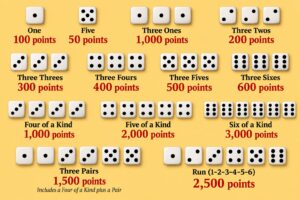
It’s worth noting that four of a kind and a separate pair can be considered three pairs. Also, if you roll four Ones, they are not worth 1,000 points like other four-of-a-kind combinations. Instead, they are worth 1,100 points, since three Ones are worth 1,000 points and the additional One is worth another 100 points.
Is There a Strategy or Is It Just Luck?
A bit of both, actually. Most decisions come down to balancing three things: how many points you have at risk, how many dice you’re about to roll, and how badly you need the points.
Know When to Bank and Pay Attention to How Many Dice You Have Left
Obviously, banking is the only way to make the points from your turn safe. That makes the value of another roll relative. Risking 100 points is very different from risking 1,500 points, even if you’re rolling the same number of dice.
Ask yourself whether you need to take the risk based on how many points Marty has. The further you fall behind, the more risks you may need to take, and vice versa.
A good rule of thumb is to stop rolling if you only have two dice left, unless you really need to take the risk.
Make the Most of Hot Dice
Hot Dice give you an interesting decision because you’re back to rolling all six dice. That’s much better than trying to squeeze another score out of one or two remaining dice, and it can lead to some enormous scores.
But keep in mind that Hot Dice don’t bank anything automatically. A spectacular turn can still end with a Farkle and a score of zero if you keep pushing your luck.

A Little Bit of Farkle History
Pinning down exactly where Farkle originated is surprisingly difficult. It’s a folk dice game that has been passed between families, friends, and regions under numerous names, accumulating different scoring rules along the way. There are games in the same family known as Ten Thousand, Dix Mille, Zilch, Greed, Hot Dice, and many more. A commercial version called Pocket Farkel appeared in the ’90s, but the game itself was already being played long before that.
There are several theories concerning the actual name of the game, but none has been officially verified. One story takes us all the way to medieval Iceland, where an English nobleman named Sir Albert Farkle supposedly played or introduced the game sometime around the 14th or 15th century.
Another theory about the name is the Texas explanation. The farkleberry is a real plant found in parts of the southern United States. According to one origin story, its berries harden when dried, and early players supposedly carved them into dice, which eventually gave the game its name. Whether that is true or not, it is certainly an interesting theory.
Another commonly repeated account is that the game came from French sailing ships in the 1600s. This would also fit with Dix Mille, French for “Ten Thousand,” being one of the names associated with this dice game. But yet again, there is no real documentation confirming this story, just as there is none confirming the other versions.
So, where Farkle originated doesn’t really change the fact that it has been taught from one generation to the next and continues to survive because the game is, well, basically, fun to play.
Want to Play More Board and Dice Games?
Check out more board and dice games below
Yatzy
Gomoku
Shut the Box
Pig (the dice game)
Four in a Row